
- IS
- FR
- Agenda
-
Partager cette page
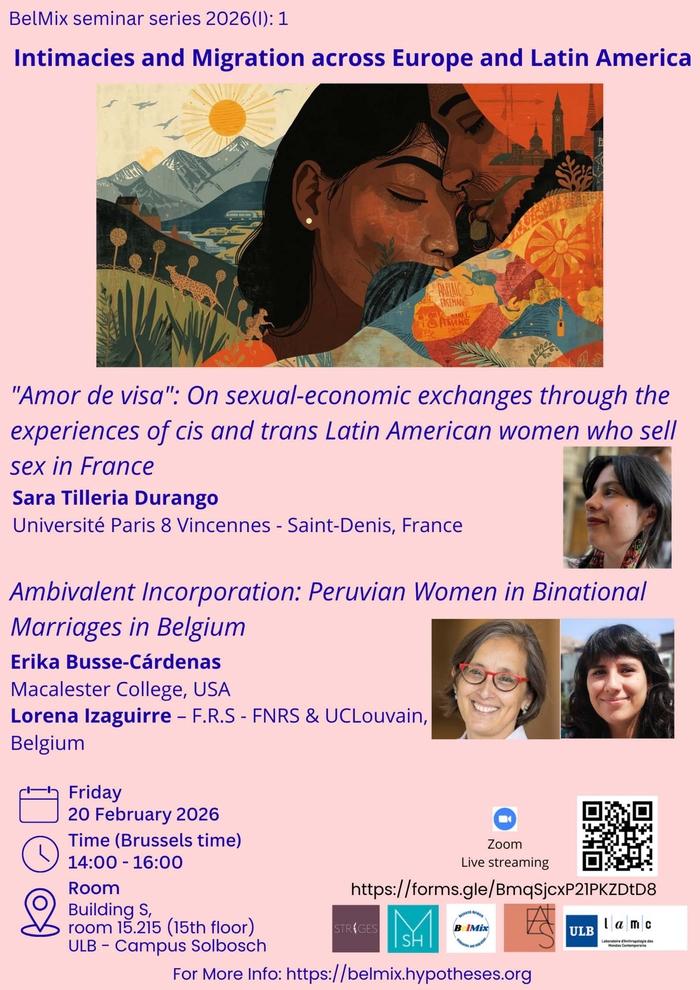
BelMix Seminar Series : 'Amor de visa': On sexual-economic exchanges through the experiences of cis and trans Latin American women who sell sex in France" by Sara Tilleria DURANGO
We are pleased to invite you to our upcoming BelMix seminar, scheduled for 20 February.
This will be a dual-presentation session featuring Sara Tilleria Durango, who will give a talk entitled “‘Amor de visa’: On sexual-economic exchanges through the experiences of cis and trans Latin American women who sell sex in France”, and Erika Busse-Cárdenas and Lorena Izaguirre, who will present their research entitled “Ambivalent Incorporation: Peruvian Women in Binational Marriages in Belgium.”
This session will exceptionally take place from 2:00 PM to 4:00 PM in Room S.15.215 (Building S, 15th floor). You may also join us online via Zoom; please see below for further information.
We look forward to welcoming many of you to this event.
Best regards,
The BelMix Seminar organizing committee
********
When: Friday 20 February 2026, 2 PM to 4 PM (Brussels Time)
Where: Room S.15.215 (Building S, 15th floor), Campus Solbosch, Université libre de Bruxelles (ULB), Avenue Jeanne 44, Bruxelles 1050.
And live-streamed online via Zoom. Register here to receive the link:
https://forms.gle/BmqSjcxP21PKZDtD8
First presentation: "'Amor de visa': On sexual-economic exchanges through the experiences of cis and trans Latin American women who sell sex in France" by Sara Tilleria Durango (Université Paris 8 Vincennes - Saint-Denis, France)
Abstract:
This paper draws on my ongoing doctoral research to examine sexual economic exchanges in contexts of migration, sex work, and gender-based violence in France. It addresses three main questions: how women involved in sexual economic exchanges name and perceive their activities; how these exchanges unfold across a continuum ranging from explicitly remunerated sexual services to intimate, affective, and long-term relationships; and how these practices intersect with migration trajectories, administrative status, and access to regularisation.
Methodologically, the intervention is based on qualitative fieldwork conducted in Paris with South American cis and trans women, combining life-story interviews, informal conversations, and ethnographic immersion. The analysis is informed by an embodied, decolonial, intuitive (Galindo, 2022), and situated feminist approach, attentive to women’s subjectivities and grounded in my own observations as an immigrant woman perceived as “Latina” in Europe.
The paper focuses on sexual economic exchanges as theorised by Paola Tabet and further developed through the notion of “erotic transactions” proposed by Martha Cecilia Ruiz (2022). These frameworks make it possible to move beyond rigid dichotomies between prostitution and marriage and to analyse a continuum of practices where sexuality, intimacy, care, emotion, and material compensation are articulated in diverse ways (Ruiz, 2022). Particular attention is paid to how women themselves resist or negotiate categories such as “sex work” or “prostitution".
Finally, the intervention examines the correlations between sex work, migration status, and access to regularisation. Also, through an intersectional perspective, it shows their particular exposure to gender-based violence. These forms of violence emerge within asymmetrical gender power relations that characterise different configurations of sexual economic exchanges, and are highly prevalent in women’s life histories, particularly in sex work as well as in affective romantic relationships with European men.
Bio:
Sara Tilleria Durango is an Ecuadorian PhD candidate in Sociology at Université Paris 8, based in Paris since 2015. Her doctoral research examines the political and legal regimes governing migration and sex work in France, with a central focus on gender-based violence and their differentiated impacts on South American trans and cis women. Drawing on an intersectional approach, her work explores participants’ subjectivities, transnational family transformations, and economic and sexual exchanges, as well as the concrete effects of these regimes on material living conditions, including access to employment and protection from violence. Prior to and alongside her academic work, she has collaborated since 2018 with several NGOs in Paris working with diverse migrant populations in situations of administrative and housing precarity. She currently works as a gender advisor in an NGO in Paris.
Second presentation: "Ambivalent Incorporation: Peruvian Women in Binational Marriages in Belgium" by Erika Busse-Cárdenas (Macalester College, USA) and Lorena Izaguirre (F.R.S - FNRS & UCLouvain, Belgium)
Abstract:
Most research on immigrant incorporation focuses on economic migrants and emphasizes labor market outcomes. This paper shifts the lens to Peruvian women in binational unions with Belgian (or other European) partners who currently reside in Belgium. We ask: to what extent does marriage or partnership with a Belgian (or European) citizen provide security and facilitate social incorporation beyond the legal status it confers? Drawing on biographical interviews, we offer an intersectional analysis comparing the trajectories of highly educated and working-class women across three migration cohorts (1990s, 2000s, 2010s). Our findings reveal the material and social struggles that shape insecure positions even among this legally “secure” group. We show how gender and class intersect to produce differentiated, unequal incorporation trajectories, arguing that binational unions have ambivalent effects and cannot be assumed to guarantee full social incorporation.
Bio:
Erika Busse-Cárdenas, Ph.D., is an Associate Professor in the Department of Sociology at Macalester College. Busse studies the social construction of motherhood in the context of transnational migration. Her research interests are connected by an underlying focus on the relationship between inequality regimes and social justice. Her scholarship examines the experiences of Latin American transnational mothers juggling gender, class, and racial hierarchies in both their home countries and the countries of reception, and the ways in which they engage in homemaking in the process. She pays particular attention to women’s experience of migration, deportation, and reunification in the U.S. and in the country of origin. Her work has been published in journals such as Sociology of Race and Ethnicity, Ethnic and Racial Studies, and Diversities.
Lorena Izaguirre is an FNRS Postdoctoral Researcher at UCLouvain (Belgium). As a sociologist, her research examines international migration, social mobility, and inequality. Her work delves into critical aspects of migration and social stratification, including South- South migration patterns, the intersectional impacts of class, race, ethnicity, and gender on migrant experiences, the relationship between spatial and social mobility, and the imbrication of precarity and informality. Her research is based on extensive fieldwork in Latin America and Europe. Previously, she was a postdoctoral researcher at the University of Neuchâtel and the nccr – on the move. She holds a Ph.D. from UCLovain.
14h à 16h
ULB - Campus Solbosch
Bâtiment S - 15ième étage
S.15.215
44 avenue Jeanne - 1050 Bruxelles
And live-streamed online via Zoom. Register here to receive the link: HERE